August 17, 2026·ClipSonar editorial
How to Tell a Reel Format Is Dying Before You Batch It
A Reel format is dying when new clips in that recipe lose to the same account's other recipes. Check public copies and originality before you batch.
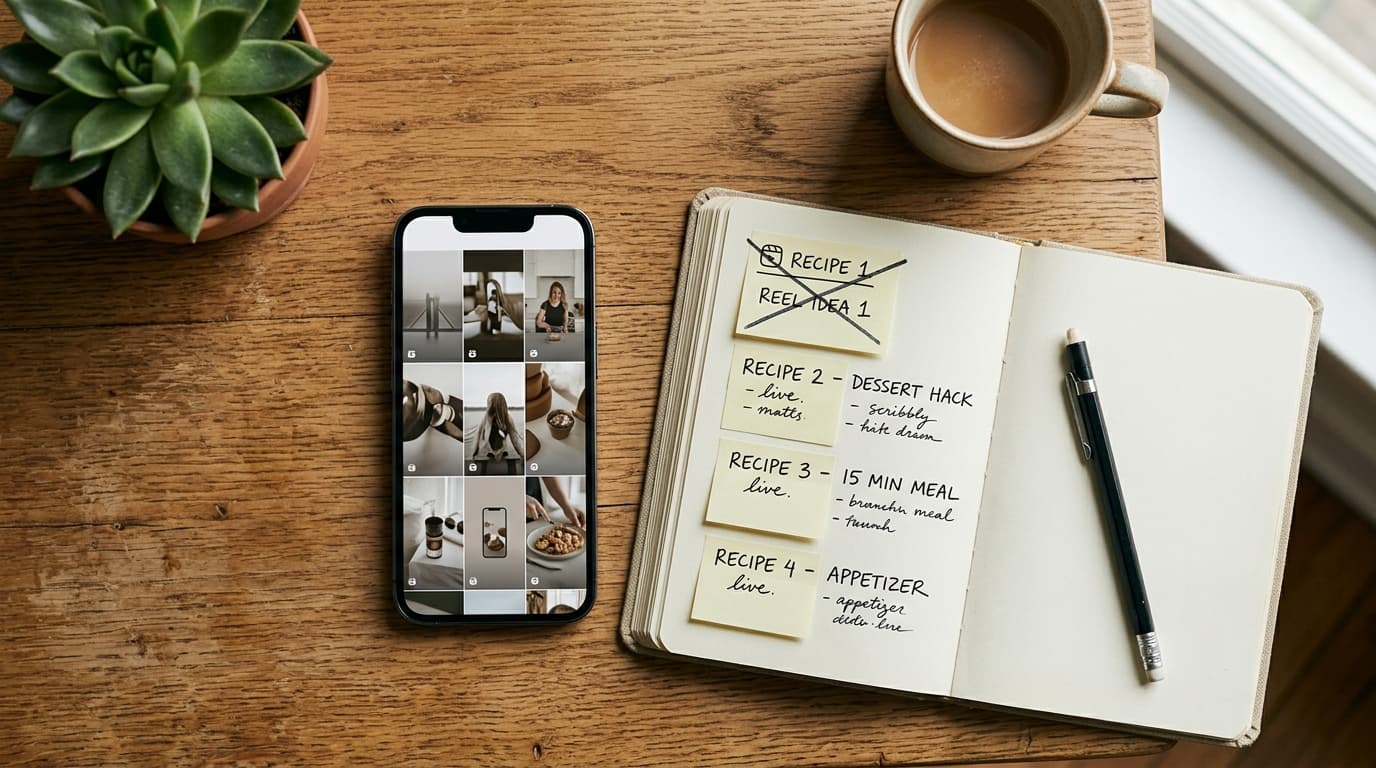
You found a recipe that worked. You blocked Thursday to film ten more. Boredom is not the signal that tells you to stop.
Instagram does not publish a "format lifespan." A format is dying when new clips in that recipe stop earning relative to the same account's other recipes, and when public clips in the topic have become near-copies. Your own Insights will not show that. They only score posts you already shipped.
Short-form as a channel is not the thing dying. In HubSpot's 2026 survey of more than 1,500 marketers, 48.6% named short-form video as the media format with the biggest ROI (source). The useful question is which recipe still earns, which needs a material edit, and which should not be batched.
Key takeaways
- A format is a reusable recipe: hook type, story shape, and duration band. It is not a mood, a trending audio, or "Reels in general."
- Kill the recipe when it loses to the same account's other recipes, not when you get tired of filming it.
- First-3-second skip on brand Reels already sits around 60% to 66%. That is a baseline, not a death line (source).
- Instagram can drop accounts that post other people's content 10 or more times in 30 days without a material change (source).
- Stay, tweak, or kill. Then write one brief, or do not shoot.
A format is a recipe, not a feeling
Name the recipe before you judge it. If you cannot fill three fields, you do not have a format. You have a vibe.
| Field | What to write | Example |
|---|---|---|
| Hook type | The first 1 to 3 seconds, named | "Stop buying another water bottle" |
| Story shape | The beats after the hook | Accusation, failed object, one swap, spoken CTA |
| Duration band | Length of the clips that actually held | 20 to 35 seconds |
Those three fields are the recipe you judge. When you stay, you add format and a proof URL and write the five-field brief. Copy the recipe. Do not copy a face, a caption, or audio you do not own.
Instagram's own recommendation tips still say to pull the viewer in within the first 3 seconds, and to keep a recommended Reel at 3 minutes or less (source). Meta's Reels chaining disclosure makes that operational: one ranking prediction is how likely someone is to watch less than three seconds, using 3-second watches, dismissals, sound-on views, and skips inside two seconds (source).
Why your own Insights miss a dying format
Native Insights report your last posts. They cannot see that twelve public accounts in the same pocket now open with the same line, the same toss, and the same CTA. They cannot see Instagram already treating newer copies as replacements for an earlier original.
If you want the wider gap, read why Instagram Insights won't tell you what to post next. This page is the decision after you already have a recipe: stay, tweak, or kill it before you book the shoot.
On Instagram, 52% of social users are most likely to interact with short-form under 60 seconds (source). That describes the channel. It does not tell you this talking-head recipe still holds for the accounts you study.
The four signals
A format is cooling when more than one of these show up together. One soft post is noise. You are looking for a pattern that repeats across new clips in the same recipe, not a single Thursday that under-indexed because you posted at a bad hour.
1. Copycat density in public clips
Search the topic and the audio page. Count how many recent public Reels share the same hook, shot list, and audio. Instagram says that when it finds two or more identical pieces, it recommends the original if the match is relatively new, using audio and visual signals. Material edits (a new point of view, parody, voiceover, remix) are not replaced (source).
If the winning original is already on-platform and newer posts are near-duplicates, the risk is replacement, not your mood.
2. Weaker hold on this recipe than on the same account's other recipes
Compare new clips in this recipe to the same creator's other recipes. Look at early skip and whether non-followers still watch. A kill signal is a rise relative to that account's other recipes, not crossing a blog's invented 40% line.
Socialinsider's January to June 2026 set of 140,000 business Reels measured first-3-second skip at 65.50% for accounts with 1,000 to 5,000 followers, down to 60.50% at 100,000 to 1 million (source). Most brand Reels already lose a majority of viewers in the open. Use that as the floor. Ask whether this recipe is worse than the rest of the grid.
3. The same creators switching recipes
If the accounts you study still post, but they have moved the winning energy to a different hook or story shape, the old recipe is no longer what they trust. That is a public tell. It is stronger than your own boredom.
4. Originality risk, or comments that skip the hook
Instagram can make an account ineligible for recommendation surfaces if it posts other people's content 10 or more times in the last 30 days without creating it or enhancing it in a material way. Eligibility returns only after the rolling count drops (source). In April 2026 Instagram said originality rules that started on Reels also cover photos and carousels, and claimed 75% of US recommendations now come from original posts (source). Treat the 75% figure as Instagram's claim, not an audited study.
A watermark, a stitch of clips, a border, subtitles, or a caption credit does not count as a material edit (source). If the next batch is other people's clips with a thin wrap, you are not refreshing a format. You are walking toward Account Status.
Comments that ignore the hook and argue the object, the price, or "seen this" are a softer tell. Use them with the other three signals, not alone.
Stay, tweak, or kill
| Call | What you see | What you do |
|---|---|---|
| Stay | New clips in this recipe still hold versus the same account's other recipes. Public copies are varied. Account Status is clean. | Write one brief. Shoot one. Do not batch ten on hope. |
| Tweak | Relative hold is slipping, but the idea still works. Length drifted. The batch is the same file across apps. Edits are cosmetic. | Change one beat: hook, duration, or a real point of view. Keep the proof URL. |
| Kill | This recipe consistently loses to the account's other recipes. Public clips are identical copies. The next batch would be unoriginal, or Account Status already flags it. | Stop. Open a different recipe. Do not film the Thursday block. |
HubSpot found 49.4% of teams reuse the same content across platforms, while 39.5% tailor it (source). Cross-posting the same file with a watermark is a tweak that Instagram already named as a recommendation problem, not a productivity win.
There is no verified study that batching itself causes underperformance. Batching is a production method. The risk is batching a recipe that public clips and relative hold already show is stale.
Before you start
You need one named recipe, one public creator or a tight topic, and about 25 minutes. You do not connect posting access.
If you are choosing between a person and a category, use creator Insights versus topic Insights. Creators can start from a single profile. You can ask the ClipSonar agent whether a recipe still holds. Treat the answer as a draft. You still open ClipSonar Insights (the playbook) and Clips (the proof URLs). The help center spells out the same Insights versus Clips split.
Step 1: Name the recipe you are about to batch
By the end of this step you have hook type, story shape, and duration band on one line.
Write the recipe in plain language. "Desk-setup Reels" is not a recipe. "Failed sit, one height fix, sit test, one product CTA, 30 to 45 seconds" is.
Verify: a collaborator can film from that line without opening your saves folder.
Step 2: Compare this recipe to the same account's other recipes
By the end of this step you know whether this recipe is the weak one on a grid that still works.
Pick one public account that still posts this recipe and at least one other. Read the playbook first, then open the proof clips. Keep URLs that actually show the beats. Drop the ones that only share a topic label. A relative test needs both: the sentence that names the recipe, and clips from the same account that prove a second recipe still holds.
Ask two questions:
- Do newer clips in this recipe lose the open worse than that account's other recipes?
- Are non-followers still watching this recipe, or only the other ones?
If you cannot name a second recipe on the same account, you do not have a relative test. Pick a different account, or start from a topic and pick who to study.
Verify: you have two or three public URLs for this recipe and at least one URL for a different recipe from the same account.
Step 3: Look at public clips in the topic
By the end of this step you know whether the category is still varied or already a copy stack.
Open a topic analyzer, or search the audio page. Scan recent public Instagram and TikTok clips. You are counting shared hooks, shot lists, and audio, not inventing a saturation score. Instagram has no official number for "how many copies is too many."
If newer posts are near-duplicates of an earlier original, Instagram's replacement rule is the risk (source).
Verify: you can point at two public clips that share the recipe and one that does not. If every clip looks the same, you are in kill or hard-tweak territory.
Step 4: Check originality risk before you batch
By the end of this step you know whether Thursday's batch is your work or someone else's.
Check Account Status if you have an Instagram login. If you are studying public accounts only, inspect the clips: watermark, unedited re-upload, or a thin credit in the caption. Instagram's help page says stitching clips or adding a watermark is not a material edit (source).
Count honestly. Would this week's batch push you toward 10 unoriginal posts in 30 days? If yes, kill the re-upload plan. Native Repost or Stories is the official path for other people's clips.
Verify: the next shoot uses your face, your words, and audio you own, or you are not shooting.
Step 5: Stay, tweak, or kill
By the end of this step you have one call and one next action.
Use the table above. Then:
- Stay: write the three-field recipe, add format and a proof URL, shoot one.
- Tweak: change one field only. If the open is the problem, rename the hook. If discovery is the job and length drifted past 60 seconds, cut toward the 30 to 60 second band. In Socialinsider's January to June 2026 set of 140,000 business Reels, that band had the highest reach rate, 5.60% (source).
- Kill: close the recipe. Do not "just film two more to see." That is how a dead format eats a week.
You can ask the agent what to ask next. You still attach a proof clip before you write the script.
Verify: you can say stay, tweak, or kill in one sentence, with a URL that justifies it.
A worked method: "stop buying another bottle"
Suppose you post home-office gear. Last month a "stop buying another water bottle" talking-head held. You want to batch ten object-toss Reels on Thursday.
Name the recipe: stop-buying hook, failed object, one swap, spoken CTA, 20 to 35 seconds.
Open one public creator who still posts that recipe and also posts overhead desk fixes. If the new bottle tosses lose the first seconds while the overhead fixes still hold, the recipe is weaker than the rest of their grid. That is signal 2.
Open the topic. If eight recent public clips use the same first line, the same toss, and the same CTA, you have copycat density. Instagram may already be recommending an earlier original.
If your Thursday plan is to re-upload those clips with a watermark, that is a kill for originality, not a tweak.
Write one of these briefs. This walkthrough is a method, not a claim that those clips live in this article.
| Call | Brief |
|---|---|
| Stay | Same hook and beats. Your kitchen. Your bottle. Audio you own. One proof URL. Shoot one. |
| Tweak | Keep the swap. Change the hook to a failed sit-down or a leak on the desk. Cut to 30 seconds. New proof URL. |
| Kill | Do not film the toss. Brief the overhead desk-fix recipe instead. |
Then use your own Insights to see if the test worked. Insights judge the post you shipped. They do not get a vote on whether the category was already full.
Common mistakes
Treating boredom as market evidence
You can be tired of a recipe that still holds. You can also love a recipe the category has already copied to death. Public clips and relative hold decide. Your mood does not.
Using a 40% skip line
Verified brand-Reel skip in the first 3 seconds is already about 60% to 66% (source). Crossing a made-up 40% line does not mean the format died. Losing to the same account's other recipes does.
Calling a watermark a refresh
A border, subtitles, or "credit in the caption" is not a material edit (source). That is how accounts walk toward the 10-in-30 rule.
Batching ten because the last one worked
One win is a sample of one. Name the recipe, run the four signals, then shoot one more. Batch after the relative test still says stay.
FAQ
Is this the same as a trend dying?
No. A trend audio can still be recommended while a story shape is exhausted. Meta predicts whether someone will use the audio. It does not publish a use-count where a sound "dies." Judge the recipe (hook, beats, length), not the sound page alone.
Do I need TikTok numbers for the same call?
Use the same qualitative test on public TikToks: relative hold on one account, copy density in the topic, and whether the next batch is your work. This article does not cite a TikTok unoriginality threshold because the official pages were not verified here.
Do Instagram Insights still matter after I kill a recipe?
Yes. Use them to judge the post you ship from the new brief. Do not use them as the only input for whether the old recipe is done.
If you want the loop in one workspace, start with a creator, a topic, or a question in the ClipSonar agent. First week is free on Basic and Pro.
Author: ClipSonar editorial. We build Instagram and TikTok content intelligence at clipsonar.com. Questions: support@clipsonar.com.
Ask what's working. Get the next Reel.
The ClipSonar agent reads public Instagram and TikTok clips, then returns hooks, ideas, or a script.
Ask the agent free7 days free on Basic or Pro